What BMI actually measures
BMI (Body Mass Index) is your weight in kilograms divided by your height in meters squared. It was designed in the 1830s as a population-level statistic, not as a personal health verdict. It tells you where your body weight sits relative to your height — nothing more.
Broadly: under 18.5 is classified as underweight, 18.5–24.9 as "normal," 25–29.9 as overweight, and 30+ as obesity. These are cutoffs, not commandments.
Where BMI falls short
- Doesn't distinguish muscle from fat. Muscular athletes are often classified as "overweight" or "obese."
- Doesn't consider fat distribution. Two people at BMI 27 can have very different metabolic risk depending on where the fat sits.
- Doesn't account for ethnicity or body frame. Standard cutoffs were derived from European populations and translate imperfectly.
- Doesn't reflect fitness, blood markers, or how you actually feel.
BMI is fine as a rough starting point. It's a poor tool for judging any individual person.
What body fat percentage measures
Body fat percentage is the share of your total body weight that's fat mass rather than muscle, bone, water and organs. It's more informative than BMI because it separates the type of tissue you're carrying.
Rough healthy ranges: 10–20% for men, 18–28% for women. Athletes can go lower; older adults are often slightly higher without concern.
Where body fat estimates fall short
Most consumer methods have real error margins:
- Bathroom scales (BIA) — convenient, but readings shift with hydration, food, and time of day. Useful for tracking direction, not for a precise number.
- Skinfold calipers — depend heavily on operator skill and body-fat distribution.
- DEXA scans — the most accurate mainstream option, but requires a lab visit and is overkill for most people.
- BodPod / hydrostatic weighing — accurate, but rarely accessible.
Chasing a decimal point of "body fat percentage" week to week is almost always noise.
The underrated middle ground: waist
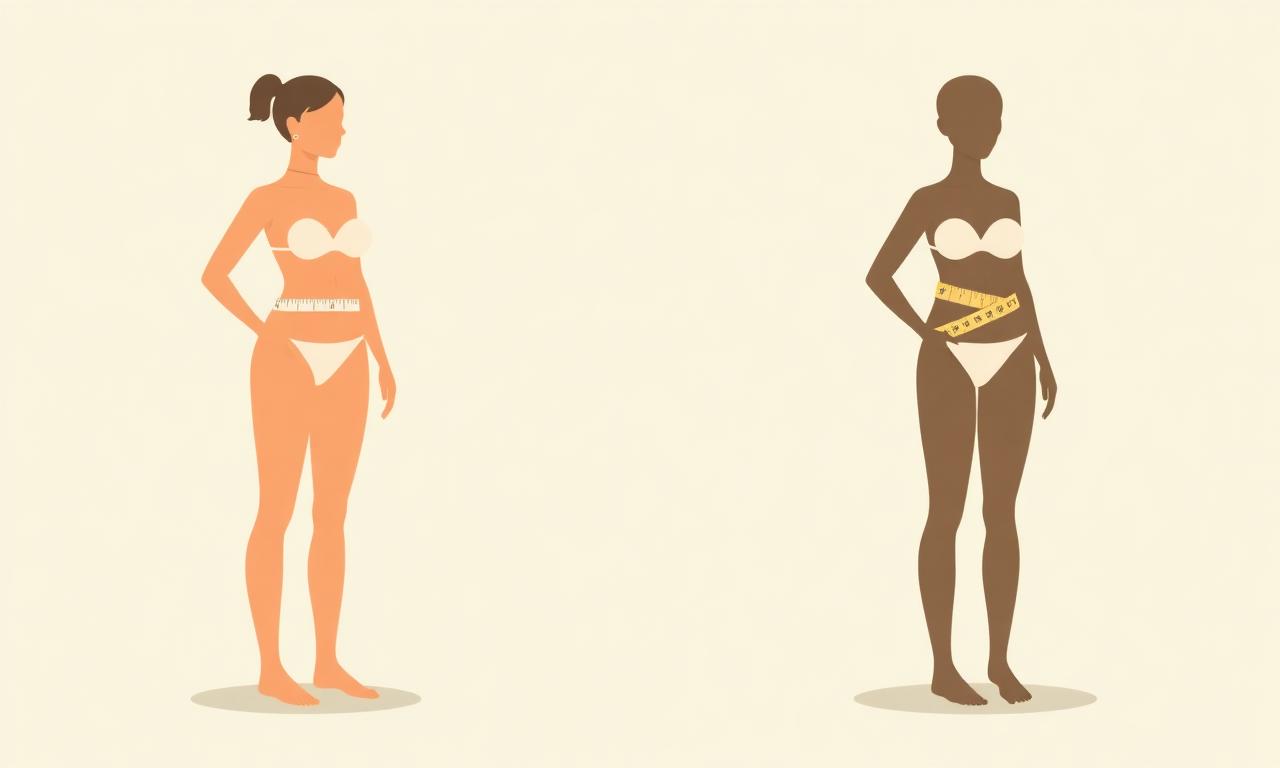
A simple tape measure around the waist (at the level of your belly button, relaxed) is one of the most useful and cheapest health metrics you can track. Waist size correlates strongly with visceral fat — the metabolically active fat that raises long-term health risk.
General reference: under 40 inches (102 cm) for men and under 35 inches (88 cm) for women is a commonly cited lower-risk threshold, adjusted slightly for ethnicity. Trend matters more than a single reading.
What to actually track
For most people, a small basket of low-cost metrics beats any single number:
- Waist measurement, monthly.
- Weekly average body weight (not daily — daily is noise).
- How clothes fit.
- Energy, sleep, mood, workout performance.
- Annual bloodwork with a clinician for the metrics that genuinely matter (blood sugar, lipids, blood pressure).
To set a realistic goal, use the weight loss goal calculator — it emphasizes a sustainable pace over any single number.
Frequently Asked Questions
Is BMI still worth using?
As a rough population-level screening tool, yes. As a personal verdict on your health, it's very limited — it ignores muscle mass, bone density, fat distribution and ethnicity.
Is body fat percentage more accurate?
It's more informative because it distinguishes fat mass from muscle mass. But most consumer body-fat estimates (scales, calipers) have significant error margins.
What's a healthy body fat range?
Broadly, 10–20% for men and 18–28% for women is considered healthy for most adults, with athletes often lower and older adults slightly higher. Individual variation is real.
Do I need to know either number?
No. How you feel, how clothes fit, resting energy, sleep and lab markers usually tell you more than either number in isolation.
What's the most useful metric?
For most adults: waist circumference plus how you look and feel. Waist is a strong, cheap, ethnicity-adjusted proxy for the fat that actually matters metabolically.
This article is for general educational purposes only and is not medical advice. BMI, body fat percentage and waist thresholds are population-level references, not diagnostic tools. Discuss your individual health with a qualified clinician.